
Introduction

A business can be profitable on paper and still struggle to pay its bills.
This happens when there is a gap between when money comes into the business and when payments need to go out. Late customer payments, unexpected expenses, payroll, supplier invoices, VAT and tax liabilities can quickly put pressure on available cash.
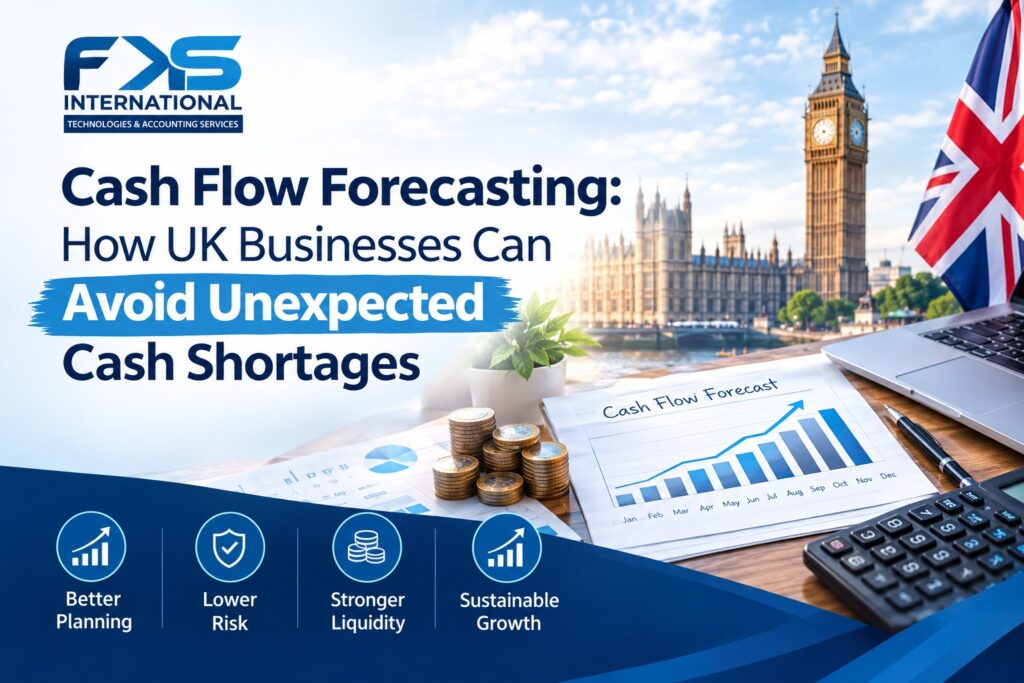
This is why cash flow forecasting UK businesses can rely on is an important part of financial management. A well-prepared forecast gives business owners a clearer view of their expected income, expenses and cash position, helping them identify potential shortages before they become a serious problem.
For UK SMEs, startups and growing businesses, cash flow forecasting can support better decisions, stronger financial planning and more confident growth.
What Is Cash Flow Forecasting?
Cash flow forecasting is the process of estimating how much money a business expects to receive and spend over a specific period.
A forecast normally considers:
- Expected customer payments
- Sales and other business income
- Supplier invoices
- Employee salaries and payroll costs
- Rent and utilities
- Loan and finance repayments
- VAT and other tax liabilities
- Equipment and technology purchases
- Marketing and operating expenses
- Unexpected or one-off costs
The objective is simple: to understand whether the business is likely to have enough cash available when it needs it.
A business may have strong revenue but still experience a cash shortage if customers pay late or large expenses become due before expected income arrives.
Why Cash Flow Forecasting Matters for UK Businesses
Cash flow problems can affect businesses of every size. However, smaller businesses may have less financial flexibility when an unexpected shortage occurs.
Regular forecasting can help businesses:
1. Identify Cash Shortages Early
One of the biggest benefits of forecasting is visibility.
If your forecast shows that cash may fall below a safe level next month, you have time to take action. You might follow up outstanding invoices, delay a non-essential purchase, negotiate supplier payment terms or arrange suitable finance.
Without a forecast, the problem may only become obvious when there is not enough money in the bank.
2. Plan for Large Payments
Some business expenses do not occur evenly throughout the year.
Tax payments, annual insurance, software renewals, equipment purchases and other major costs can create temporary pressure on cash flow.
Including these payments in your forecast allows you to plan for them instead of treating them as unexpected expenses.
3. Manage Working Capital More Effectively
Working capital is closely connected to cash flow.
Businesses need to manage:
- Accounts receivable
- Accounts payable
- Inventory
- Short-term liabilities
- Available cash
A cash flow forecast can highlight where too much money is tied up in unpaid invoices or stock, allowing management to take corrective action.
4. Make Better Business Decisions
Should you hire another employee?
Can you afford new equipment?
Is it the right time to expand?
Can you increase your marketing budget?
These decisions should not be based on revenue alone. A forecast helps you understand how a decision could affect your future cash position.
How to Create a Cash Flow Forecast
Creating a useful forecast does not have to be complicated. The key is to use realistic numbers and keep the forecast updated.
Step 1: Start With Your Current Cash Position
Begin with the amount of cash currently available to the business.
This should include relevant business bank accounts and other immediately available cash.
Your opening balance becomes the starting point for the forecast.
Step 2: Estimate Future Cash Inflows
Next, identify the money you expect to receive.
This may include:
- Customer invoices
- Online sales
- Recurring subscriptions
- Deposits
- Business loans
- Investments
- Other income
Do not automatically assume that every invoice will be paid on time.
If your customers normally pay within 30 days, your forecast should reflect the expected payment timing rather than simply recording the invoice as immediate cash.
Step 3: Calculate Expected Cash Outflows
List the payments your business expects to make.
These can include:
- Payroll
- Supplier payments
- Rent
- Utilities
- Software subscriptions
- Marketing
- Insurance
- Loan repayments
- Equipment
- Professional fees
- VAT
- Corporation Tax
- Other business taxes
This is where accurate bookkeeping and accounting records become particularly important.
Step 4: Include Tax and Compliance Payments
Tax liabilities should never be treated as an afterthought when forecasting cash flow.
Depending on the business, future payments may include VAT, Corporation Tax, PAYE-related obligations and other liabilities.
Businesses using tax preparation services UK can benefit from having financial records organised ahead of filing deadlines, while tax compliance services UK can support more accurate and timely tax-related processes.
For companies with significant tax obligations, corporation tax services UK can also form part of broader financial planning.
Step 5: Calculate Your Closing Cash Balance
Once expected inflows and outflows have been estimated, calculate the projected closing balance.
The basic formula is:
Opening Cash Balance + Cash Inflows − Cash Outflows = Closing Cash Balance
For example:
| Cash Flow | Amount |
|---|---|
| Opening cash | £30,000 |
| Customer payments | +£45,000 |
| Other income | +£5,000 |
| Payroll | -£20,000 |
| Supplier payments | -£25,000 |
| VAT & tax payments | -£10,000 |
| Other expenses | -£8,000 |
| Projected closing cash | £17,000 |
If your projected cash balance becomes too low, the forecast gives you an early warning.
How Tax Planning Can Improve Cash Flow
Tax is one of the areas that businesses need to consider carefully when preparing cash flow forecasts.
Unexpected tax liabilities can create significant pressure, particularly for businesses that have experienced rapid growth.
Effective tax planning services UK can help businesses understand upcoming obligations and incorporate them into financial forecasts.
Businesses may also use business tax services UK to support their wider tax requirements, while tax advisory services UK can help business owners make informed decisions about tax-related financial planning.
For more complex situations, tax consulting services UK can form part of a broader financial strategy.
Plan for VAT Payments
VAT can create a cash flow challenge when a business collects VAT from customers but does not set the money aside for the eventual payment.
Businesses should account for expected VAT liabilities within their cash flow forecast.
Accurate bookkeeping and timely VAT return filing services UK can help businesses maintain better visibility over their VAT position.
Prepare for Corporation Tax
Corporation Tax can also create a substantial cash requirement.
Rather than waiting until a payment deadline approaches, businesses should estimate their potential liability and include it in their forecast.
This is one reason corporate tax advisory services UK can be valuable for businesses that need more structured tax planning.
Why Small Businesses Should Not Ignore Cash Flow Forecasting
Small businesses often operate with limited cash reserves.
A single late-paying customer or unexpected expense can therefore have a much bigger impact than it would on a larger organisation.
Businesses looking for tax preparation services for small businesses UK should also consider how tax liabilities affect their overall cash position.
Similarly, tax filing services for companies UK should be viewed as part of a wider financial management process rather than an isolated compliance task.
The objective is not simply to complete a tax return. It is to understand the financial obligations coming up and make sure the business is prepared for them.
Cash Flow Forecasting for Startups
Startups face a different set of challenges.
They may have:
- High initial operating costs
- Limited revenue
- Significant technology expenses
- Marketing investment
- Hiring costs
- Irregular customer payments
- Funding requirements
This makes forecasting particularly important during the early stages of a business.
A startup should ideally create different scenarios, such as:
Best case: Revenue grows faster than expected.
Expected case: Revenue follows the current sales pipeline.
Worst case: Customer payments are delayed and expenses increase.
Scenario planning helps founders understand how much financial flexibility they actually have.
Where tax considerations are significant, startup tax advisory services UK can also support better financial planning.
5 Ways UK Businesses Can Prevent Cash Shortages
1. Improve Invoice Collection
Late payments are one of the most common causes of cash flow pressure.
Set clear payment terms, issue invoices promptly and follow up overdue invoices consistently.
2. Review Your Forecast Regularly
A forecast is only useful when it reflects current information.
Update it when:
- A major customer payment changes
- A new expense appears
- Payroll changes
- A large purchase is planned
- Tax liabilities change
3. Separate Profit From Cash
Profit and cash are not the same thing.
A business can report a profit while having limited cash because revenue may still be tied up in unpaid invoices.
Always monitor both profitability and cash availability.
4. Build a Cash Reserve
Where possible, maintain a cash buffer for unexpected expenses.
The appropriate amount will depend on the business model, operating costs and revenue stability.
5. Use Professional Financial Support
Accurate bookkeeping, accounting and financial forecasting provide the information needed to make better cash management decisions.
Businesses may combine business tax planning services UK with bookkeeping, accounting and financial advisory support to create a more complete financial management strategy.
How Outsourcing Can Support Cash Flow Management
Managing bookkeeping, accounting, payroll and tax internally can become difficult as a business grows.
Outsourcing selected finance functions can give business owners access to organised financial information without building a large internal finance team.
For example, outsourced tax services UK can support businesses with tax-related requirements, while bookkeeping and accounting support can help maintain accurate financial records.
This can make it easier to monitor:
- Cash inflows
- Outstanding invoices
- Upcoming expenses
- Tax liabilities
- Payroll commitments
- Monthly financial performance
The result is better financial visibility and more time for business owners to focus on growth.
Cash Flow Forecasting and Financial Advisory
Cash flow forecasting should not exist in isolation.
It works best when it forms part of a wider financial strategy that includes budgeting, management accounts, tax planning and financial analysis.
Professional financial forecasting services UK can help businesses evaluate expected financial performance and identify potential pressure points.
Similarly, budgeting and forecasting services UK can help connect day-to-day cash management with longer-term business objectives.
For businesses that need broader support, financial advisory can help turn financial data into practical decisions.
The Role of Accurate Bookkeeping
You cannot build a reliable forecast from unreliable financial data.
If your books are incomplete or transactions have not been correctly categorised, your forecast may give you a misleading picture of the business.
Good bookkeeping helps ensure that you have visibility over:
- Money owed to you
- Money you owe suppliers
- Regular operating costs
- Tax liabilities
- Payroll expenses
- Actual cash movements
This is why bookkeeping should be considered the foundation of effective cash flow forecasting.
Final Thoughts
Cash shortages are often easier to prevent than to fix.
For UK businesses, cash flow forecasting provides an early-warning system that can highlight potential financial pressure before it affects day-to-day operations.
By monitoring expected income, expenses, payroll, supplier payments and tax obligations, businesses can make more informed decisions and maintain greater control over their finances.
Tax planning also plays an important role. Whether you need tax preparation services UK, tax compliance services for businesses UK, corporation tax support or broader financial advice, incorporating expected tax liabilities into your cash flow forecast can help prevent unpleasant surprises.
FKS International provides bookkeeping, accounting, payroll, tax and financial advisory support for businesses looking to improve financial visibility and plan for sustainable growth.
Frequently Asked Questions
1. What is cash flow forecasting?
Cash flow forecasting is the process of estimating future cash inflows and outflows to determine whether a business will have sufficient cash to meet its financial commitments.
2. Why is cash flow forecasting important for UK businesses?
It helps businesses identify potential cash shortages, prepare for major expenses, plan for tax payments and make better financial decisions.
3. How often should a business prepare a cash flow forecast?
The frequency depends on the business. Growing businesses with changing cash positions may benefit from weekly or monthly forecasting, while others may use a monthly or quarterly approach.
4. Can cash flow forecasting help with tax planning?
Yes. Forecasting upcoming VAT, Corporation Tax and other tax liabilities allows businesses to plan for payments instead of facing unexpected cash requirements.
5. What is the difference between cash flow and profit?
Profit measures revenue minus expenses over an accounting period. Cash flow measures the actual movement of money into and out of the business. A profitable business can still experience a cash shortage.
6. How can small businesses improve cash flow?
Small businesses can improve cash flow by collecting invoices faster, controlling expenses, forecasting future payments, maintaining accurate bookkeeping and planning for tax liabilities.
7. Can outsourcing help businesses manage cash flow?
Yes. Outsourced bookkeeping, accounting and financial advisory support can provide more accurate financial information and help business owners monitor their cash position.
8. How does tax planning affect business cash flow?
Effective tax planning helps businesses anticipate tax liabilities and incorporate expected payments into their cash flow forecasts, reducing the risk of unexpected financial pressure.